
When a potential customer asks ChatGPT or Gemini a question about your industry, the AI does not generate its answer from thin air. It pulls from specific content that it has learned to trust, and it structures its response around specific topics it considers important. Most organizations create content based on instinct or keyword research. The Content Brief in Citate’s platform takes a different approach. It combines multiple layers of analysis into a single, actionable tool that shows you exactly what questions your audience is asking, which topics have the highest visibility potential, and how to structure your content so that generative engines are more likely to cite it. Instead of guessing what might work, you are working from evidence about what actually gets cited.
The Content Brief is organized into three tabs: Topics, GEO Outline, and Full Article. Each tab serves a different purpose in the content creation process, and understanding how they work together is essential for getting the most out of the tool. The tab strip in the UI shows them in left-to-right order as Full Article, GEO Outline, Topics, with Full Article as the default landing tab. We cover them below in workflow order, because that mirrors how the data flows from topic research to structured outline to finished article.
The Topics tab is where the Content Brief surfaces the topics that Citate’s algorithm has determined are applicable to the last 7 days of LLM queries for your prompt. Each topic appears as a heading with related keywords listed underneath and a set of influencing questions below that. These influencing questions represent the specific questions that large language models are actively asking and answering about each topic. The purpose is clear: write to these topics to increase the chances that your perspective will be utilized by the LLMs. This is data you cannot reliably gather through manual research alone. Citate’s Iterative Representative Sampling methodology systematically analyzes how large language models respond to queries in your domain, which sources they cite, and what those sources have in common.
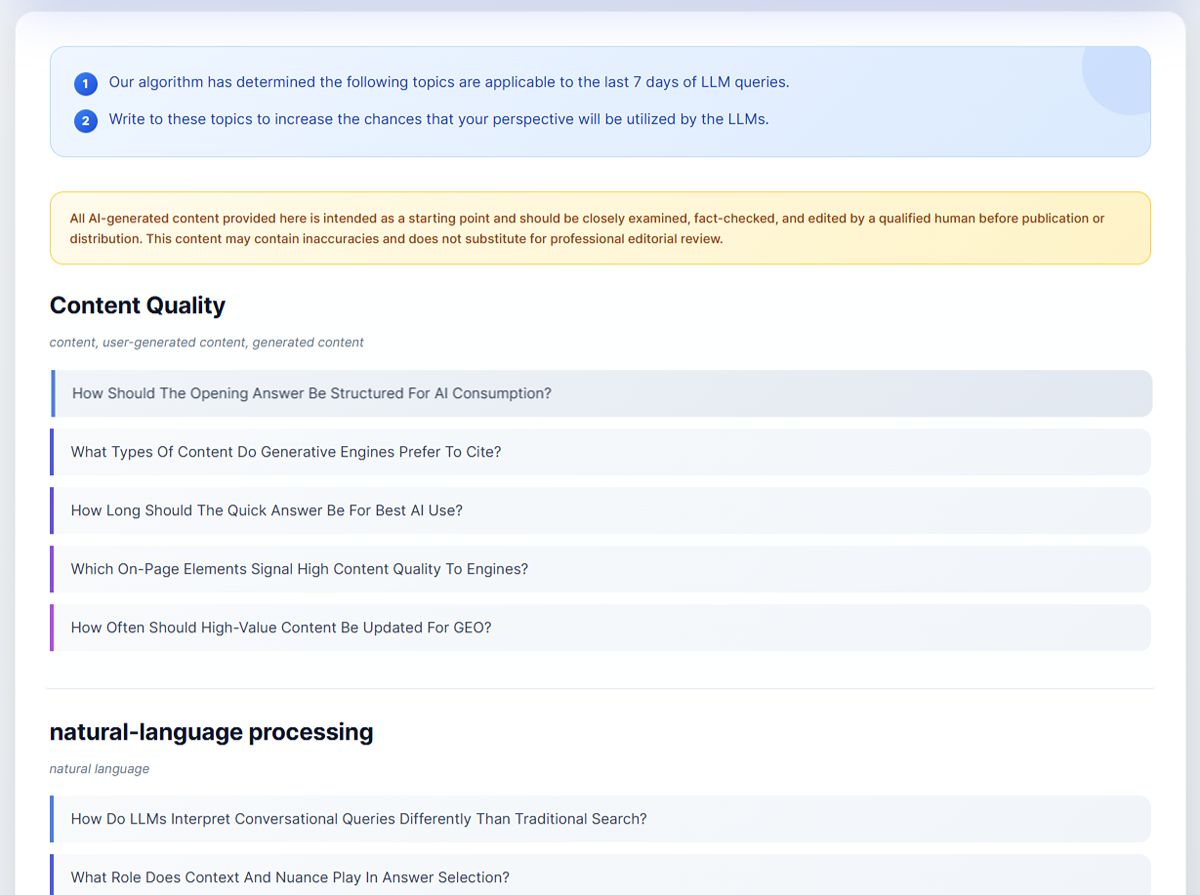
The Topics tab. Each topic appears as a bold heading (here “Content Quality”) with related keywords in italic underneath, followed by a list of influencing questions, the specific questions LLMs are actively asking and answering about that topic. Writing content that addresses these questions directly increases the chance your perspective gets cited.
The GEO Outline tab takes those topics and transforms them into a structured, ranked outline that you can use to create highly Generative Engine Optimized content. After identifying and ranking hundreds of topic clusters for your prompt over 7 days, Citate generates a complete outline with a suggested article title, an introductory paragraph, and individually ranked sections.
At the top of the outline you will see a Meta Description card showing the suggested description text and a character count indicator that flags whether the description is too short or too long (for example, “103/160 Could be longer”). Next to it sits a “Generated with: GUIDE” badge that shows which brief type produced the outline and a “View Log” link for the underlying generation context. A “Copy Full Outline as HTML” button at the top lets you grab the entire outline in one click for paste-into-CMS workflows.
Each ranked section then includes the suggested H2 question heading, a topic tag chip showing which topic cluster the section belongs to, a blue Rank: N pill indicating its visibility importance, and, where applicable, one or more format indicator pills such as “Has bullet list”, “Has numbered H3s”, or “Has table” showing the content structure that AI models most often cite for that question. A single section can carry multiple format indicators at once. Below those tags you get an expanded-answer snippet that models what a direct response to the section’s question should look like, a Suggested H3 Subheadings list giving you a starting framework for the section’s internal structure, and a row of Subtopics chips highlighting the specific angles the section should cover. A per-section copy-as-HTML icon in the top right of each section lets you grab individual sections rather than the full outline.
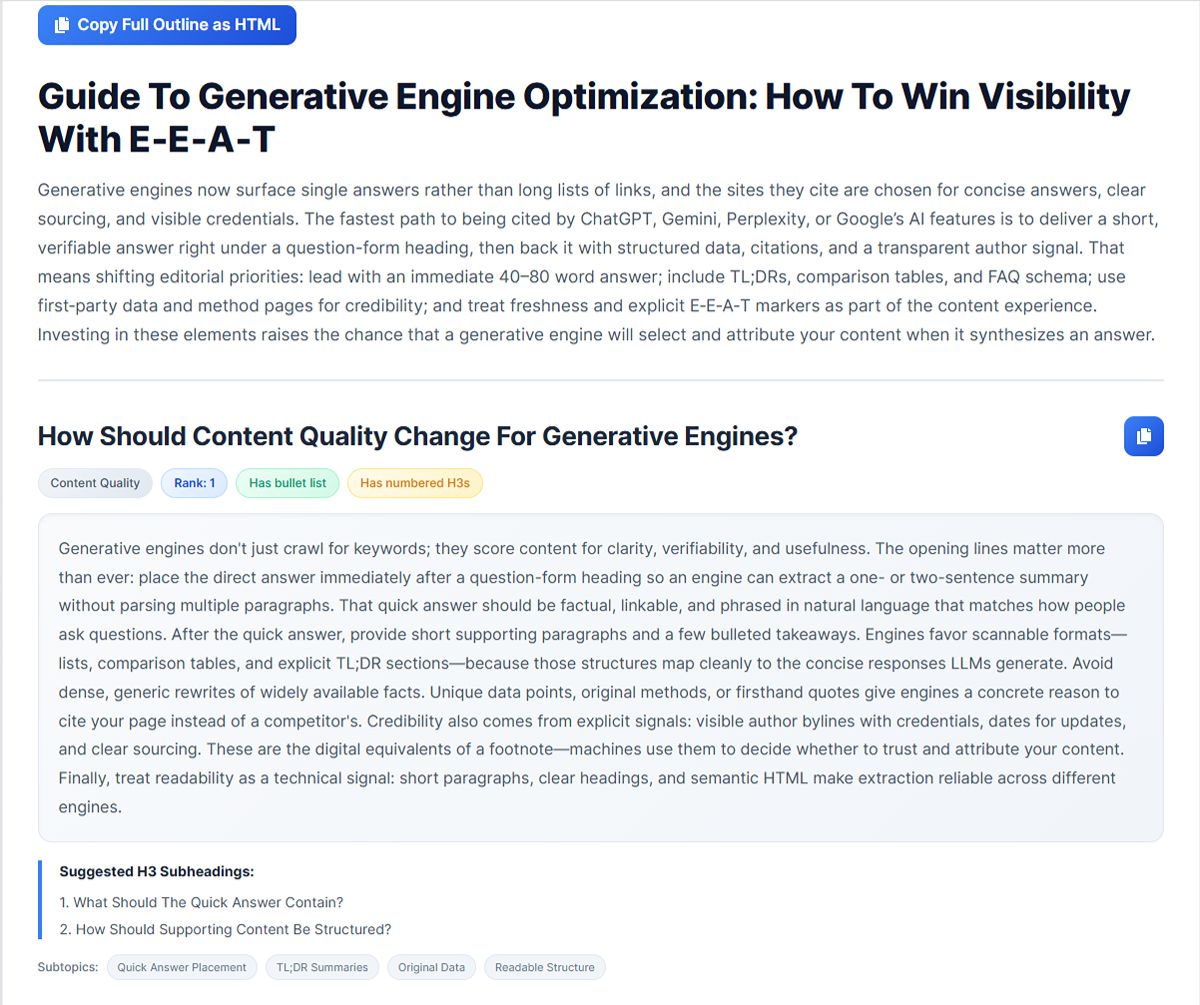
The GEO Outline view. Each ranked section displays its topic tag (here “Content Quality”), the blue Rank pill, format indicator pills (here both “Has bullet list” and “Has numbered H3s”), an expanded-answer snippet, suggested H3 subheadings, and Subtopics chips at the bottom. The blue copy icon in the top right of each section lets you grab individual sections, and the “Copy Full Outline as HTML” button at the top of the page grabs the entire outline at once.
The Full Article tab is the configuration screen for generating a complete, AI-assisted article. Here you can optionally provide your website URL to enable internal linking, brand detection, and writing style analysis. You can set narrative and tone preferences or let Citate auto-detect both based on your existing website content.
The key decision on this tab is selecting your brief type. The available options are Guide for comprehensive, research-backed articles with sections, links, and FAQ content; Branding for brand-forward content with heavy internal linking and competitor comparison; Comparison for head-to-head content with highlights, feature tables, and anonymous competitor comparison; and Report for data-driven analysis with cited studies, tables, and formulas.
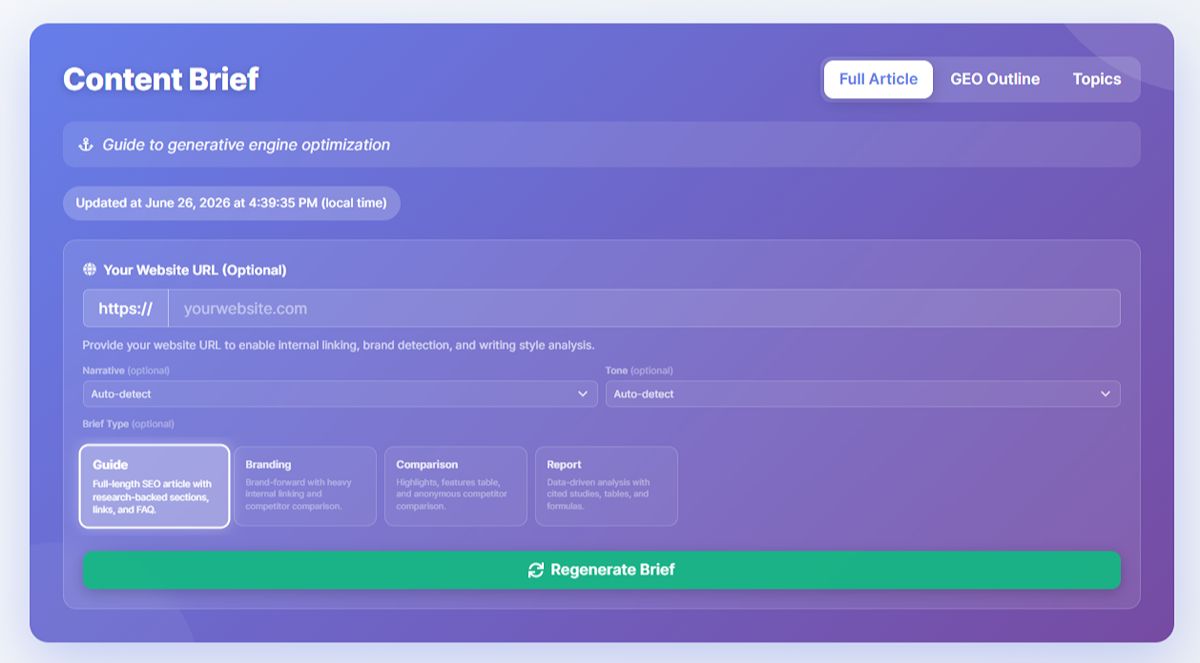
The Full Article tab configuration screen. Optionally add your website URL to enable internal linking and brand detection, set Narrative and Tone (or leave them on Auto-detect), and pick your Brief Type from the Guide, Branding, Comparison, and Report cards. The green Regenerate Brief button kicks off the generation, which the platform notes may take 10+ minutes.
Once configured, the system generates a full article using an agentic approach that integrates information from your website, competitor websites, and emerging best practices in GEO. Regeneration is not instantaneous. The platform itself notes that it “may take 10+ minutes” because the underlying agent is working through multiple research and writing passes. When a campaign does not yet have a generated article, the tab shows a “Generate Now” button instead of the rendered article.
Once an article exists, the tab shows a revision-history pager (for example, “Updated at [date] (1 of 2)”) with prev/next chevrons so you can browse prior generations. The current version carries the same “Generated with: GUIDE” badge as the outline, a “View Log” link, a “Copy Article as HTML” button, and a yellow human-review disclaimer banner reminding you that the output requires fact-checking and editing before publication. The output requires human review because the system is making editorial decisions about what to include, how to frame it, and what sources to cite.
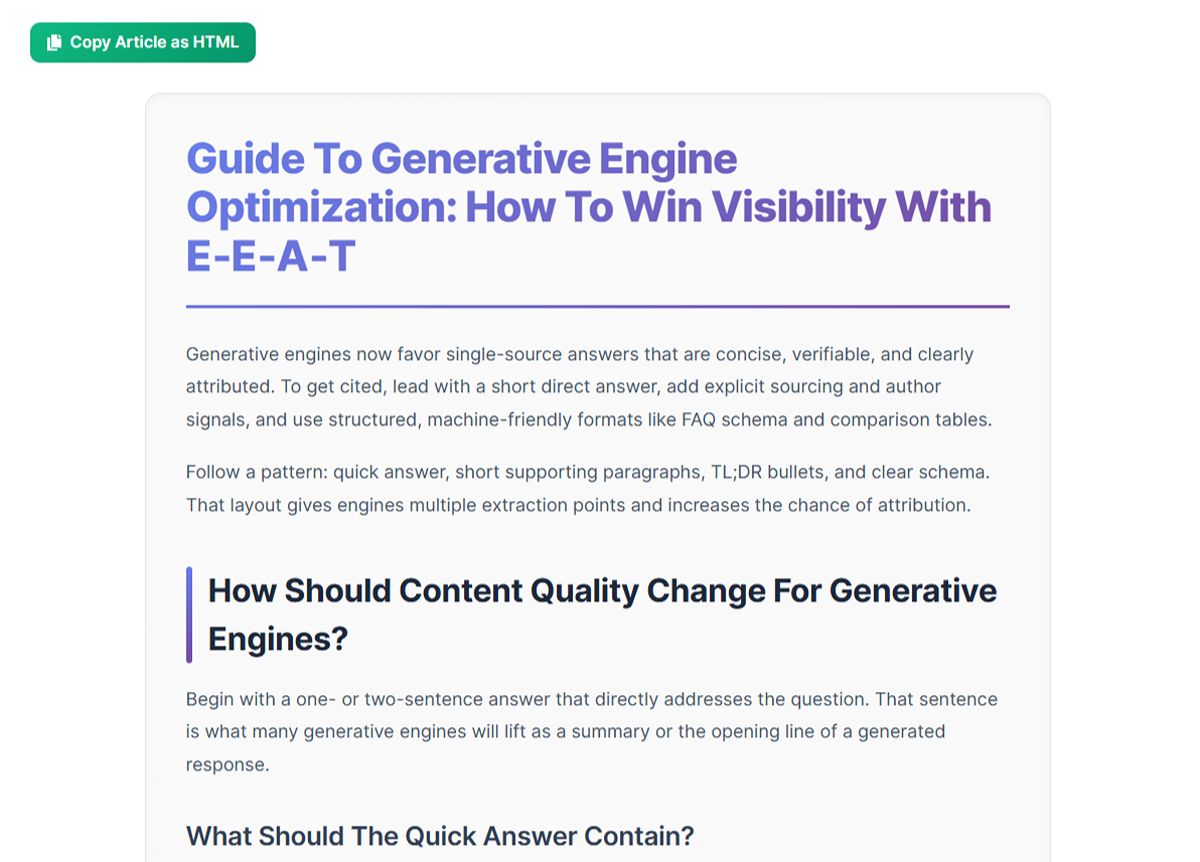
The Full Article rendered output. The generated article includes the title, intro paragraph, H2 question headings with their answers, and inline citation links woven into the body text. The green Copy Article as HTML button at the top makes it easy to move the finished article straight into your CMS.
Users new to Citate often ask why the topics in their Content Brief do not always match their Topic Visibility report. This difference is intentional and reflects fundamentally different purposes for each tool.
Topic Visibility shows every topic your website already ranks for. It is a retrospective analysis of past content performance. The Content Brief, by contrast, is forward-looking. It prioritizes topics based on:
Think of it this way: Topic Visibility is your rearview mirror. The Content Brief is your navigation system, pointing toward opportunities rather than documenting historical performance.
The GEO Outline is the streamlined approach, purpose-built for creating or refreshing content with focused intent. Because each section is modular and includes its own expanded-answer snippet, you can rearrange, combine, or omit sections based on editorial judgment. You are not locked into a predetermined narrative structure. Instead, you get the building blocks and the strategic rationale for arranging them.
This approach works well for content refreshes when existing content has dropped in visibility. The GEO Outline tells you which subtopics to prioritize in an update by showing you exactly which ranked sections and influencing questions matter most right now. It is also effective for FAQ sections, where each question-answer pair from the outline can become a standalone FAQ item requiring minimal additional writing. And it works well when you are targeting a single topic and need to identify the sub-questions that matter most for visibility.
The format indicators on each section are particularly valuable. When the outline tells you a section “Has bullet list”, “Has numbered H3s”, or “Has table”, it is reflecting patterns in which content structure actually gets cited by generative engines for that specific topic. Following these indicators gives you an evidence-based starting point for formatting decisions rather than relying on guesswork.
The Full Article feature operates at a different scale and incorporates far more analytical depth. It synthesizes ranked topics, comprehensive snippets, and best practices into a complete article recommendation. It identifies internal linking opportunities for topical authority building and suggests external links for added credibility and source diversity. It recommends structural elements like bulleted lists, tables, and definition paragraphs based on GEO best practices. And it generates article length recommendations based on content type and topic scope.
The Full Article is the more ambitious option because it is not simply pulling from your own database. It is synthesizing competitive intelligence and industry insights using an agentic approach. This is why the output requires human review. The system is doing work that would typically take a research team hours, but that work still needs editorial judgment and factual verification.
This approach works best for new, high-stakes content when you are establishing authority in a new domain or addressing your most competitively important topic. It is also valuable for topic exploration when you need to understand the full landscape of a topic, not just the critical questions. And it serves complex, multi-faceted topics where ranking questions by importance and providing a suggested structure adds real value.
The decision between GEO Outline and Full Article comes down to three factors:
When using the Full Article tab, the brief type you select shapes the entire structure and approach of the generated content. Each brief type is designed for a different content goal.
Guide is the most common choice for GEO-focused content. It produces a comprehensive, research-backed article with sections, links, and FAQ content. This works well for how-to queries, step-by-step processes, and topics where authority comes from clarity and completeness.
Branding is brand-forward content that positions your specific offering with heavy internal linking and competitor comparison. This is valuable when your company itself is the answer, though it requires careful optimization because generative engines are cautious about citing promotional content.
Comparison produces head-to-head content with highlights, feature tables, and anonymous competitor comparison. This works well when the search intent is specifically about comparing options. The structure does the heavy lifting, allowing readers to evaluate differences quickly.
Report produces data-driven analysis with cited studies, tables, and formulas. This is best for topics where evidence and research are the primary value.
The narrative setting controls the overall writing approach of the generated content. Your options are:
The tone setting controls the voice and style of the generated content. Your options are:
Understanding the trade-off between these tone options is important: generative engines cite neutral and analytical content more frequently because it appears less biased. Promotional articles are less helpful for GEO than educational content, but they should not be neglected if you create them. If you are writing branding or comparison content, apply the same structural principles to maximize the chance of citation.
You can let Citate auto-detect both narrative and tone based on your existing website content, or you can manually select them. Auto-detection is useful if you want consistency with your existing brand voice. Manual selection is better if you are deliberately shifting approach for a particular content type.
As we mentioned in the Citate GEO Guide, the Grounding Budget is a critical framework that refers to the finite amount of processing capacity generative engines allocate when responding to a query. This is roughly 2,000 words of content. From that full pool, only about 32% actually survives into the final generated response.
This constraint changes how you should structure your content. Generative engines show strong lead bias, meaning the opening paragraphs of your article are selected almost wholesale, while later sections are sampled more selectively. Your direct answer must appear in the first 40 to 60 words of your article, not buried in the middle of a thoughtful introduction and not positioned after a lengthy preamble. The answer comes first, which is the inverse of traditional essay structure most people learned in school.
Definition paragraphs are the most frequently cited format. If your opening sentence reads something like “X is defined as…” or “Y refers to…,” you are using a structure that generative engines are predisposed to select and cite. Semantic density also matters more than total word count. Articles with a high concentration of named concepts, organizations, and specific information tend to be cited more frequently than articles with generic language.
Consider this comparison. A generic opening might read: “There are many different options when choosing a financial advisor. Some focus on investments, while others take a broader approach.” A denser, more citable opening reads: “A fiduciary financial advisor is legally required to act in the client’s best interest, unlike broker-dealers operating under a suitability standard. Key distinctions include fee structure (fee-only versus commission-based), regulatory oversight (SEC-registered versus FINRA-regulated), and scope of services (investment management versus comprehensive financial planning).” The second example is more specific, more useful, and more likely to be cited by a generative engine because it provides direct value.
The influencing questions from the Topics tab can expand your content production without proportionally expanding your effort when you approach them strategically.
One effective workflow used by many Citate users is treating the influencing questions not as subsections of a single article, but as the seeds for multiple content pieces. Citate’s system can cycle through up to 5 different prompts per week, with each prompt accumulating one week of answer data. This means you can run 5 prompts simultaneously, gathering data in parallel. At the end of a full week, you have comprehensive data to produce up to 20 pieces of new content.
If you approach the Content Brief strategically, the process looks like this: select your top-ranked topic from the brief, extract 3 to 5 influencing questions from that topic, convert each question into a separate FAQ article or short-form guide of 300 to 800 words each, interlink these articles internally so they build authority collectively, and then set up prompts for 4 other topics and repeat this process.
This is not content factory thinking. It is efficient, scalable thinking that respects quality. Each piece remains original, editorial, and genuinely valuable. You multiply your output without proportionally multiplying your effort. The workflow is particularly effective for FAQ sections. Rather than hand-writing FAQs that are often generic and unhelpful, you let the Content Brief identify the actual questions your audience cares about. Each answer is direct, addressing the question fully without unnecessary preamble. Your FAQ section becomes both more valuable to users and more attractive to generative engines.
Content refreshes are often more valuable than new content creation because they target existing visibility that can be improved with strategic updates. This process ensures your refreshes are data-driven, targeted, and effective.
Run an analysis of your topic visibility over the past 60 to 90 days and identify pieces that have dropped in visibility. Focus on content that had strong visibility at some point but has deteriorated, as this indicates fixable gaps rather than fundamental topic unfitness.
Run a new Content Brief against the same topic you originally targeted. This captures how the landscape of questions has evolved and what new competitive information has emerged since your original article was published.
Set your original article side-by-side with the fresh GEO Outline recommendations. Identify which new influencing questions are present in the brief but missing from your article. Check whether the ranked sections and the structural recommendations have changed, and whether your article aligns with current best practices.
Assess whether you need a light refresh, such as adding new sections, updating definitions, or refreshing examples, or a more substantial rewrite. Light refreshes work when the article’s core is sound but it is missing specific sub-questions. Substantial rewrites are necessary when the article’s structure is misaligned with current GEO best practices or when competitive depth has increased significantly.
Implement your updates focusing on adding definition paragraphs for new concepts, integrating new sub-questions as sections, updating examples and statistics to current data, refreshing your dateModified schema markup, and adding a visible last-updated timestamp. Ensure internal linking is strategic and points to related content and newer pieces you have created.
Track visibility changes for 30 to 60 days after your refresh. Compare against the brief’s predictions. Note which types of updates generated the most visibility lift, as this teaches you what matters most for your specific domain. This approach to refreshes is far more strategic than generic “add more content” advice. You are not guessing. You are targeting specific, identified gaps based on real data.
There is no single right answer to whether you should create one comprehensive article or multiple focused articles addressing different angles of the same topic. The best approach depends on several factors that emerge from your Content Brief data, and exploring those factors often reveals that the conventional instinct to write one big piece is not always the best strategy.
Multiple articles are strategically superior when the topic is broad enough to legitimately be addressed from multiple perspectives. For example, “How to choose a CRM” might be addressed from the perspective of different company sizes, different industries, or different use cases. Multiple articles also work well when competitors are dominating with single, comprehensive articles. If five competitors each have a 4,000-word article on the same topic, a single 4,000-word article from you is unlikely to outrank all of them. But three focused articles each addressing a specific angle can collectively capture more citations and build more topical authority.
The Topics tab often reflects this multiplicity. If the influencing questions can be clearly segmented into distinct narrative arcs, then separate articles are not just defensible but strategically superior. The key principle is that these articles must be genuinely distinct. They are not the same article rephrased. They are different pieces with different angles, different data, and different internal linking strategies that collectively establish your authority in the space.
On the other hand, a single comprehensive article works better when the topic is narrow enough that splitting it would create thin content, or when the influencing questions all feed into a single coherent narrative. Sometimes your Content Brief data makes this clear by clustering all the influencing questions tightly around one central theme rather than branching into distinct subtopics. The goal is always to match your content structure to what the data shows about how your audience is actually asking questions and how generative engines are actually selecting sources.
The Full Article feature is powerful because it aggregates competitive intelligence, identifies best practices, and generates comprehensive initial content in minutes. But this power comes with a responsibility: serious human review. The system is agentic, which means it is making decisions about what to include, how to frame it, and what sources to cite. Generative systems can sometimes produce confident assertions of facts that are subtly wrong, quotations slightly misremembered, or statistics cited in the wrong context. The platform itself surfaces this with a yellow disclaimer banner on every generated article, reminding you that all AI-generated content “should be closely examined, fact-checked, and edited by a qualified human before publication.”
Your review process should address four areas:
This review process typically takes 15 to 30 percent of the time it would take to write the content from scratch. That is why the Full Article feature is valuable despite the review overhead. You gain significant time savings while maintaining editorial control and accuracy.
The Content Brief’s structural recommendations are derived from evidence, not stylistic preference. When you see format indicators like “Has bullet list” or “Has table” on a GEO Outline section, or when you see a recommendation for H2 subheadings formatted as questions, these come from patterns in which content actually gets cited by generative engines. Understanding and applying these practices systematically increases your citation rate.
Definition-led paragraphs appear frequently in cited content and follow a consistent structure: term, definition, elaboration. For example: “Semantic density refers to the concentration of named entities and specific concepts within a given passage. Content with higher semantic density tends to be cited more frequently by generative engines because the higher concentration of specific information provides more direct answers to user queries.” This format is algorithmically favored and should anchor your key concept sections.
Bullet lists outperform paragraph-based instructions for how-to content. When the influencing question is procedural, generative engines cite bullet lists more readily because they are easier to integrate into structured responses and present information in scannable form.
Tables outperform prose for comparisons. When the topic involves comparing options, a simple table with clear headers outperforms a sophisticated paragraph comparing the same items, even if the table is relatively basic. As we mentioned in the Citate GEO Guide, generative engines show a preference for structured formats that can be easily extracted and presented to users.
Standalone sections are essential. Each section of your article should be comprehensible on its own. Generative engines do not necessarily use your full article. They sample passages. A section that only makes sense in context of three previous sections is unlikely to be cited. Instead, each section should restate the main concept, then expand on it with specifics so that it works as a standalone answer.
Freshness signals also matter. Generative engines pay attention to content freshness, particularly for topics about current events, emerging trends, or evolving regulations. Implement dateModified schema markup with updates whenever you refresh content. Include visible “Last Updated” markers that signal to both users and generative engines that the content is current. Use temporal markers within content like “As of 2026” to ground content in time and reinforce freshness.
The Citate platform is not just a planning tool. It is also a measurement framework that allows you to assess whether your implementation is working and iterate based on evidence.
After you have implemented content based on a brief’s recommendations, you can measure success through several key areas. Citation frequency shows whether generative engines are citing your content in responses to the target queries, which Citate’s Analytics tools display directly. Visibility changes indicate whether the topics you targeted in the brief improved in your overall Topic Visibility report. Traffic patterns reveal whether you are seeing increases in direct traffic from AI-powered search and answer engines. And comparative performance answers how your targeted content performed relative to articles you created without brief guidance, teaching you which aspects of the platform’s recommendations work best for your particular domain.
The most efficient teams structure their content production around a repeatable cycle that respects both the power of the platform and the reality that human judgment remains essential. In the first week, run your Content Brief on 5 topics simultaneously and review the ranked topics and influencing questions for each. Identify which topics merit Full Article generation versus GEO Outline approach. In the second week, generate Full Articles for your 2 to 3 most important topics and create GEO Outlines for your remaining topics. Begin human review focusing on factual accuracy and brand alignment. In the third week, complete verification, extract influencing questions as standalone FAQ content, develop your internal linking strategy, and plan content refreshes based on fresh brief data. In the fourth week, publish new content with proper schema markup, execute content refreshes on existing pieces, and begin monitoring visibility changes over the following 30 to 60 days.
This feedback loop is valuable because it teaches you which aspects of the platform’s recommendations work best for your particular domain and audience. Over time, you develop an intuition for which questions matter most, which formatting approaches resonate, and how to adapt the recommendations to your specific context.
The Citate platform exists to close the gap between what your audience is asking and what your content actually answers. The Topics Visibility tab shows you where you stand right now. The Links tab reveals which sources generative engines already trust. The Content Brief shows you the questions that matter, gives you a ranked and structured starting point through the GEO Outline, and does the heavy lifting of synthesizing competitive intelligence into a draft you can refine through the Full Article feature. Used together and used consistently, these tools transform content creation from guesswork into a repeatable, evidence-based process. The organizations that build this into their regular workflow are the ones that see sustained visibility gains across generative engines, not because they publish more, but because every piece they publish is grounded in data about what actually gets cited.
