
The Topics Visibility Tab extracts and aggregates the semantic topics that emerge from language model responses to your queries. These are distinct concepts, themes, and propositions the AI surfaces as relevant. Rather than logging which websites appear, Citate performs granular analysis, ranking these topics by frequency and importance across hundreds of responses.
Consider a query about fiduciary responsibility in financial advisory. The language model might surface topics including the legal definition of fiduciary duty, the difference between fiduciary and suitability standards, specific regulations like Dodd-Frank, common breaches and consequences, compliance demonstration methods, and fiduciary insurance. Each is a distinct semantic topic, ranked by how often it appears and how central it is to the AI’s understanding of the domain. A topic appearing in nine out of ten responses carries more weight than one appearing in two.
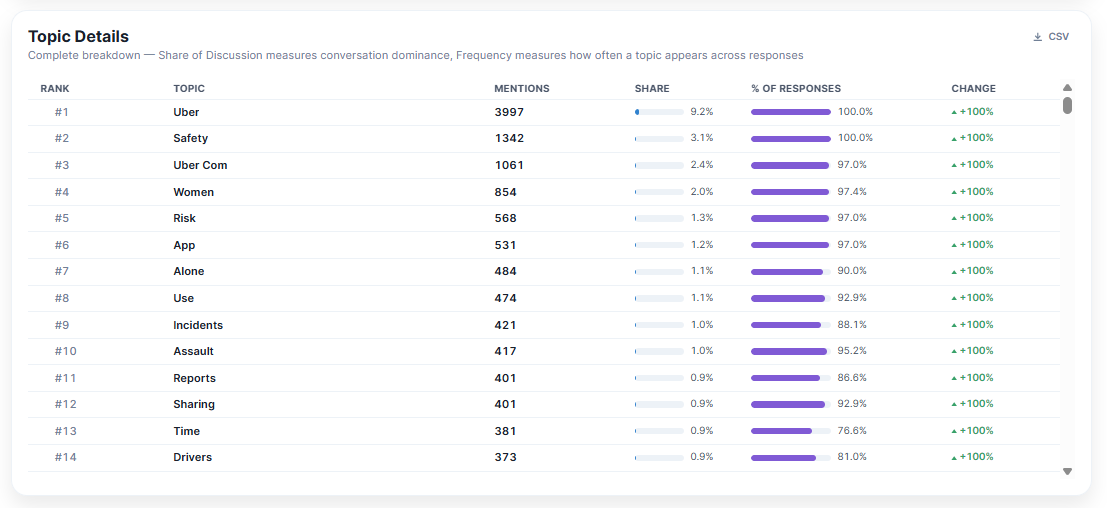
The Topic Details table gives the complete breakdown for every topic: total mentions, share of discussion, the percentage of responses it appears in, and how it has changed over the period.
The default view is a 7-day over 7-day comparison, showing which topics the AI discusses most frequently and whether importance is shifting week to week. You can expand to 30 days for longer-term shifts, drill down to specific prompts for individual topic generation, or zoom out to folder level for aggregate patterns across related queries.
The platform ranks every topic it extracts by importance, which is a combination of how often the topic appears across AI responses and how central it is to actually answering the question. Think of it as a priority list: topics at the top are concepts that AI models treat as essential to your domain, while topics further down cover niche details or edge cases.
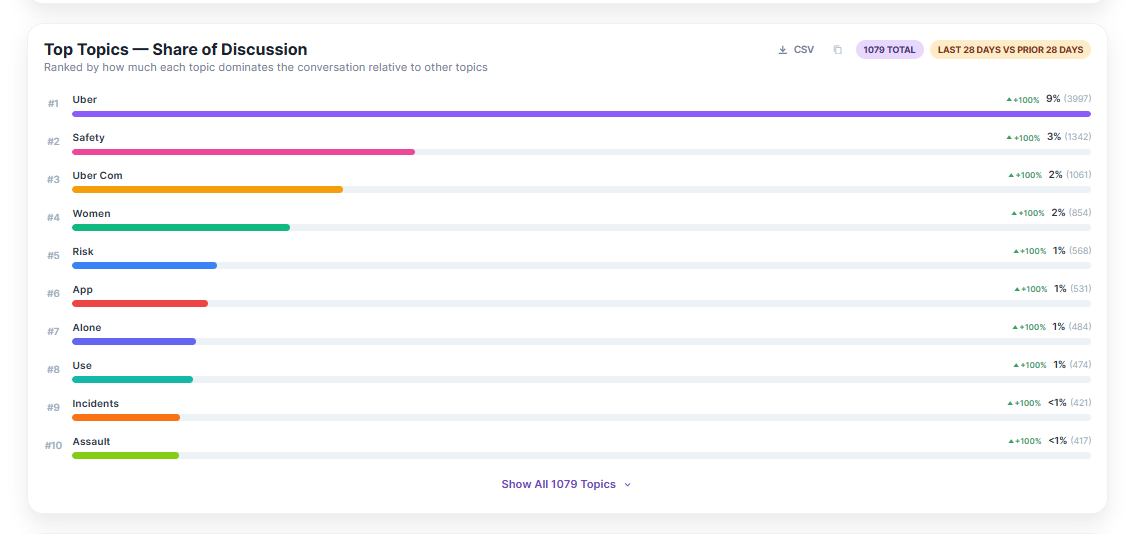
The Top Topics view ranks every topic by how much it dominates the conversation relative to other topics, with the change versus the prior period shown for each.
This ranking is your resource allocation map. High-ranked topics are where you need strong, comprehensive content because that is where AI models expect to find authoritative answers. Lower-ranked topics still matter for completeness, but they are secondary investments. If “fiduciary duty” consistently ranks at the top of financial advisory topics, any content strategy in that space should address it thoroughly.
The Topics Visibility Tab reveals strategic opportunities that operate across three distinct time horizons. Each horizon requires different content approaches, different measurement expectations, and different decision-making speeds. Understanding these three layers transforms topic data from interesting observation into actionable strategy.
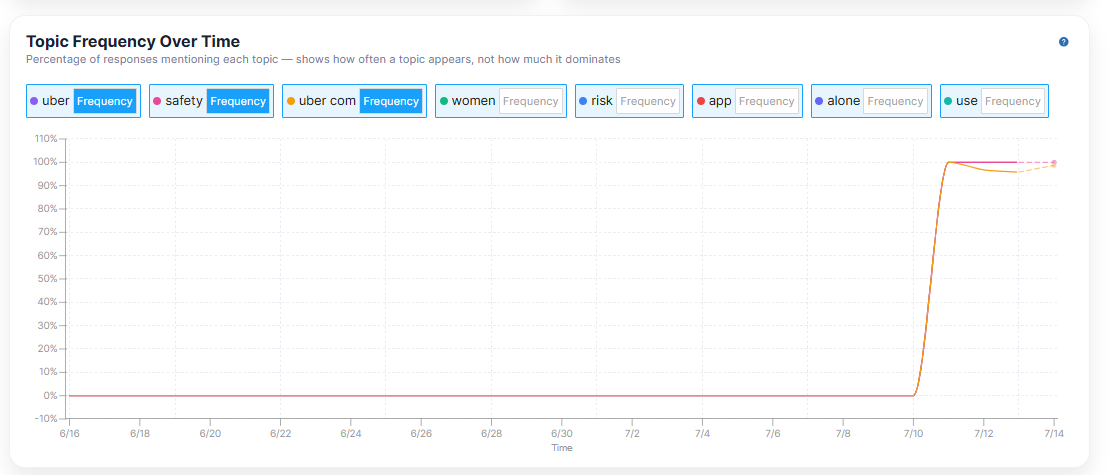
The Topic Frequency Over Time chart plots the percentage of responses mentioning each topic, showing how often a topic appears rather than how much it dominates. Sudden movement like this is exactly what the time horizons below help you interpret.
The 7-day over 7-day comparison view surfaces hot topics, which are semantic concepts experiencing growth in AI responses. Each topic shows a percentage increase or decrease week over week, and you can use this to spot trending topics in your space. A topic trending upward signals that AI systems are starting to treat this concept as more important, often before competitors have noticed or created content addressing it.
This matters because trending topics are frequently underserved. If a topic is growing in importance but your competitors have not yet published strong content on it, you have a window of opportunity. That window is time-limited because competitors will eventually catch up, so acting within weeks rather than months is important.
Your short-term strategy is straightforward: identify trending topics in the 7-day comparison, verify the shift is consistent across multiple related prompts (not just a one-off spike), assess whether you already have content covering it, and create or refresh content that addresses the topic thoroughly. As outlined in the Citate GEO Guide, “thoroughly” means answering the main question and the natural follow-up questions around it. For example, if “pet insurance” is trending in a veterinary niche, your content should not just define what pet insurance is. It should also cover what policies typically include, how to compare providers, common exclusions, and how to file a claim. These are the follow-up questions AI models will look for answers to.
The standard 7-day view examined consistently over weeks reveals which topics are durable, meaning they remain ranked highly across multiple observation periods. These are the anchoring topics of your domain. For a personal injury law firm, that might be “statute of limitations.” For a home renovation company, “building permits.” For a pet food brand, “ingredient safety.” These are not passing trends. They are the concepts that define your space, and they warrant your deepest content investment.
Over a three to six month horizon, your goal is to build strong, thorough content around these anchoring topics. As we mentioned in the Citate GEO Guide, the most effective approach is a hub-and-spoke model. You create one main piece that covers the core topic in depth, then support it with shorter articles that answer specific related questions.
Take a home renovation company where “building permits” consistently ranks high. The main piece would cover what permits are required, how to apply, typical costs, timelines, common mistakes, and what happens if you skip the process. Then you support it with focused articles like “Do I need a permit for a kitchen remodel?” and “How long does a building permit take in my city?” When AI models see that your site answers the main question and all the related questions around it, they treat you as the most complete source on that subject.
The 30-day view tells you whether the topics AI considers important in your space are staying consistent or shifting. This matters because AI models are constantly being updated. The companies behind ChatGPT, Gemini, and other platforms regularly retrain their models with new data, change how they weigh different sources, and adjust their algorithms. A topic that AI treated as very important last month might carry less weight after a model update. This does not mean the topic stopped mattering to your customers. It means the AI’s understanding of your industry changed.
This is why Citate is transparent about the fact that topic data has a shelf life. It reflects what AI models think right now, not what they will always think. Checking your topic data at least once a month keeps your strategy aligned with reality rather than outdated assumptions.
For example, imagine you run a plumbing company and “tankless water heaters” has been a top-ranked topic for months. Then one month you notice it has dropped significantly while “heat pump water heaters” has risen sharply. That shift might reflect a real change in what AI models consider the most relevant recommendation for homeowners, possibly driven by new energy efficiency regulations or a wave of recent articles about heat pumps. Rather than ignoring this shift or panicking about it, you investigate: is this consistent across multiple prompts and models? If so, it is time to create or refresh content around heat pump water heaters. If the shift only shows in one model, it may be worth monitoring for another few weeks before investing resources.
The Topics Visibility Tab allows examination at two different levels of granularity, and understanding when to use each is essential to effective strategy.
Prompt-level analysis focuses on a single, specific query, giving you precision about what language models consider important when answering that particular question. This is valuable when developing content strategies for narrowly focused questions. If your query is “What are the compliance requirements for fiduciary advisors?” the topics that emerge are highly specific to that question, informing equally focused content pieces like targeted blog posts or narrowly scoped guides directly addressing those requirements.
As a general rule: for narrow questions, use prompt-level topics to inform sections within a larger blog post, or as the spine of a focused guide. Prompt-level analysis also reveals where language models struggle. If you run a highly specific prompt and receive topics seeming tangential or misaligned with the query, that may indicate an industry-wide content gap that no one has filled yet. When no strong content exists on a specific subtopic, language models fill the uncertainty with whatever they can find, even if that content is not ideal. This is a real opportunity: if you create quality content in that gap, you become the go-to source across AI platforms.
Folder-level analysis aggregates topics across an entire set of related prompts within a specific folder structure in your Citate workspace, giving you a bird’s-eye view of how language models conceptualize your entire domain or a major sub-area. This is valuable for understanding your overall authority landscape and planning larger content initiatives. A folder-level analysis for “financial advisory” might show dozens of distinct semantic concepts, with the highest-ranked representing true pillars from the AI’s perspective.
Folder-level analysis is where you identify opportunities for broader, hub-focused content pieces. A folder showing “fiduciary duty,” “suitability standards,” “fee structures,” and “regulatory compliance” ranked highly suggests these four topics are the true conceptual centers of financial advisory in AI responses, warranting your deepest content investment. It can also reveal content gaps where your competitors have covered important subtopics that you are lacking, giving you a clear picture of where to focus your next content efforts.
Different language models produce completely different sets of topics from the same prompts. A query run against Claude might surface entirely different topics than the identical query run against ChatGPT or Gemini. This is not a quirk reflecting fundamental differences in how models were trained, what data they emphasize, and how they reason about topics within your domain.
This has a practical implication: you cannot develop a single, model-agnostic content strategy based solely on topic analysis. You could attempt it, but you would be optimizing for an average that does not actually exist in any specific model’s behavior. The transparent approach is developing model-specific strategies. If Claude citations matter to your business, use the Topics Visibility Tab filtered to Claude-only data. Identify the topics that matter most within Claude’s semantic framework. Then ensure your content addresses those topics specifically.
This does not mean creating entirely different content for different models. Rather, it means understanding that your content must be comprehensively semantic, rich enough to address multiple framings of the same core topic, because different models will frame things differently. The Citate GEO Guide emphasizes that your content should achieve semantic density: a high concentration of independently citable propositions. When you build content this way, addressing a topic and its related subtopics across all LLMs from multiple angles with multiple supporting propositions, you naturally become visible across different models’ topic preferences because you are addressing the underlying domain comprehensively.
The 30-day view reveals topic momentum. Some topics are rising, some are stable, and some are declining. This information matters but requires careful interpretation. A common error is treating every topic shift as a signal requiring action. A topic rising 15% week to week might be genuinely emerging or might be statistical fluctuation from a single large AI response emphasizing it. Reacting to noise wastes resources.
Why does calibrated interpretation matter? Because your content budget is finite and your strategic focus must be disciplined. Not every signal merits immediate action. A more calibrated approach distinguishes between signal and noise. Rising topics showing 15-50% growth week to week warrant monitoring without immediate action. Wait for confirmation that the rise is consistent across multiple observation periods and multiple related prompts. Hot topics showing 100%+ growth deserve investigation: Is the shift consistent across prompts? Is it driven by one model or multiple? If consistent and multi-model, you have a genuine content opportunity window. Stable topics showing 5% or less variation are your reliable anchors, informing core hub-level content strategy. Declining topics showing 15%+ decline warrant investigation but not overreaction. A decline might reflect a model update rather than genuine domain shift. Monitor for three to four weeks before deciding whether to significantly reduce investment.
The Topics Visibility Tab helps you understand what AI models consider important. But the real question is: how do you know if your efforts are actually working? That is where Share of Voice comes in.
Share of Voice measures how often AI responses mention your brand or cite your content as a percentage of all responses for a given topic. Citate tracks this metric as part of its GEO analytics, so you can see it directly alongside your topic data.
The connection between topic strategy and Share of Voice is simple. When you consistently create strong content around the topics that AI models rank as important, your Share of Voice for those topics should grow over time. It will not happen overnight, and it will not happen evenly across every topic. But as your content depth builds, the trend should be clear.
If you are covering high-ranked topics thoroughly and your Share of Voice is still not growing, that is a signal to reassess. It could mean your content is not complete enough, that competitors have stronger coverage, or that you are focusing on the wrong model or audience. Share of Voice is your north star metric. The Topics Visibility Tab is how you figure out where to aim.
One important thing to understand about AI models is that they are probabilistic. The same query run twice can produce different responses. This is not a flaw. It is how generative models work. If you ask ChatGPT a question once and base your entire strategy on that single answer, you are building on a sample size of one. That is guessing, not strategy.
The Topics Visibility Tab solves this by aggregating data across hundreds of responses, multiple prompts, and multiple time periods. When you look at folder-level data across 30 days, you are working with a much more reliable picture. This is why checking your topic data at least once a month is essential. AI models evolve, your competitive environment shifts, and the topics that mattered last quarter might not carry the same weight this quarter.
Think of the Topics Visibility Tab as a monitoring system, not a one-off audit tool. It shows you what language models are learning about your domain, reveals content gaps, identifies trending topics where you have a window to establish visibility, and tracks whether your strategy is still aligned with what AI considers important.
The organizations that get the most out of Citate are the ones that use it this way: systematically, regularly, and with a willingness to adjust based on what the data shows. Visibility in generative AI responses is not accidental. It is the result of deliberate, informed decisions about what to create, when to refresh, and where to invest your content efforts.
